Application Development Solutions

Table of Content
Effective application development solutions are the technical blueprints that transform abstract business ideas into high-performance digital products. These solutions encompass the entire software lifecycle—from strategic discovery and architectural design to coding, deployment, and continuous scaling. By integrating modern tech stacks with agile methodologies, these services ensure that software is not just functional, but inherently resilient and market-ready.
Key Takeaways
- Strategic Alignment: Success begins with matching technical architecture to specific business goals and user needs.
- Full-Cycle Support: Comprehensive solutions cover everything from initial product discovery to post-launch scaling.
- Scalability & Performance: Utilizing modern frameworks like React and Node.js ensures the application can handle growing user bases without degradation.
- Agile Execution: Iterative development cycles allow for rapid pivots based on real-world market feedback.
- Security First: Integrating cybersecurity best practices from day one protects both user data and brand reputation.
- Expert Partnerships: A high-energy innovation partner acts as an extension of your team, bridging the gap between vision and execution.
Defining Modern Application Development Solutions
In the current tech ecosystem, an application is rarely a static piece of code. It is an evolving asset. Application development solutions refer to the holistic set of processes, tools, and technical expertise required to build, deploy, and maintain software in a competitive landscape.
This includes custom web applications, mobile platforms, and complex enterprise systems designed to solve specific operational pain points.
For a founder, this means moving beyond "outsourcing" and toward an integrated partnership. It involves platform engineering that focuses on developer productivity and robust infrastructure. It also demands a deep understanding of product-market fit, ensuring that the features being built actually resonate with the target audience and drive revenue.
Table 1: Core Components of Effective Development Solutions
| Phase | Primary Objective | Critical Deliverables |
|---|---|---|
| Discovery | Validate business logic & requirements | User stories, Wireframes, Technical Roadmap |
| Design | Optimize user experience (UX/UI) | High-fidelity prototypes, Design systems |
| Development | Build functional, clean code | MVP, API integrations, Core features |
| Quality Assurance | Ensure reliability and security | Bug reports, Automated test suites, Security audits |
| Deployment & Scaling | Launch and expand market presence | Cloud infrastructure, CI/CD pipelines, Analytics |
The Strategic Discovery Phase: Laying the Foundation
Before a single line of code is written, a successful project must survive the scrutiny of a discovery workshop. We view this phase as the bedrock of application development solutions. It is where we align your ambitious vision with technical possibility. We deconstruct your business model to identify the "North Star" metrics your software must support.
During this stage, we focus on identifying the Minimum Viable Product (MVP). This isn't about building a "cheap" version of your idea; it’s about identifying the leanest set of features that delivers maximum value. By ruthlessly prioritizing, we reduce your time-to-market and protect your capital from being wasted on features that users might never touch.
Technical Feasibility and Risk Assessment
Every innovation comes with inherent technical risks. Can the proposed FinTech application handle high-frequency transactions with millisecond latency? Will the healthtech platform comply with strict HIPAA or GDPR regulations? Our discovery process uncovers these hurdles early.
We provide a clear-eyed assessment of the tech stack, third-party integrations, and potential bottlenecks that could impede your growth.
Custom Software Engineering: Beyond Generic Templates
Off-the-shelf software often forces your business to adapt its processes to the tool. Custom application development solutions do the opposite—the tool adapts to your business. We leverage modern, high-performance frameworks like React, Node.js, and Python to build systems that are flexible enough to evolve alongside your startup.
Our engineering philosophy is built on the principle of clean architecture. This means writing code that is modular, readable, and easy to maintain. When your user base grows from 1,000 to 1,000,000, a clean codebase ensures that the system doesn't collapse under its own weight. We focus on building software development services that prioritize long-term stability over short-term hacks.
Front-End vs. Back-End Excellence
The front-end is your user’s world. It must be fast, intuitive, and visually compelling. Our Design Services ensure that the user interface isn't just a skin, but a functional extension of the user's intent. Meanwhile, the back-end serves as the engine room. We build robust APIs and database structures that serve data quickly and securely, ensuring a seamless experience across all devices.
Key Technologies for Scalable Apps:
- React/Next.js: For dynamic, SEO-friendly user interfaces.
- Node.js: For high-concurrency back-end logic and real-time features.
- Python/Django: Ideal for rapid development and data-heavy applications.
- PostgreSQL/MongoDB: Relational and non-relational data management tailored to your needs.
- AWS/Azure/GCP: Cloud infrastructure that scales automatically with your traffic.
Agile Transformation and Development Sprints
Static, "waterfall" development models are relics of the past. Modern application development solutions thrive on agility. We operate in two-week sprints, providing you with tangible progress at every milestone. This transparency ensures you are never in the dark about the status of your product.
Agile is more than just a buzzword; it’s a commitment to iterative improvement. By releasing early and often, we gather real-world data. We use these insights to refine the product roadmap, ensuring that the final solution aligns perfectly with product-market fit. This collaborative approach turns you from a "client" into an active participant in the engineering journey.
The Role of Continuous Integration and Deployment (CI/CD)
We don't believe in "big bang" releases that break everything upon launch. Instead, we implement sophisticated CI/CD pipelines. This allows us to push updates and fixes frequently with minimal downtime. Automation is key here—automated testing ensures that new features don't introduce regressions, maintaining high architectural integrity throughout the building process.
Specialized Solutions for Industry Innovators
Different industries face unique technological challenges. A one-size-fits-all approach fails when dealing with the high-stakes requirements of modern verticals. Our expertise spans several high-growth sectors, allowing us to provide tailored application development solutions that respect industry-specific nuances.
FinTech and Travel Tech
In the world of finance, security and precision are non-negotiable. Building FinTech solutions requires an obsession with data encryption, transaction integrity, and regulatory compliance. Similarly, Travel Tech demands massive real-time data handling for bookings, inventory management, and API integrations with global distribution systems.
AI Integration and Data Science
We are no longer just building apps; we are building intelligent systems. By incorporating AI & Data Science, we enable businesses to leverage predictive analytics, natural language processing, and machine learning models. Whether it’s an AI-driven chatbot for customer support or a recommendation engine for an e-commerce platform, we integrate advanced logic to give your product a competitive edge.
// Example: A simple Node.js/Express structure for an AI-integrated endpoint
const express = require('express');
const aiModel = require('./services/aiService');
const app = express();
app.post('/api/v1/predict', async (req, res) => {
try {
const inputData = req.body.data;
const result = await aiModel.generatePrediction(inputData);
res.status(200).json({ success: true, prediction: result });
} catch (error) {
res.status(500).json({ success: false, message: 'AI Processing Error' });
}
});
Cooperation Models: The Right Engagement for Your Growth
Choosing the right way to work together is just as important as choosing the right tech stack. We offer various cooperation models to stay flexible to your current stage of growth. Whether you need a dedicated team to own the entire project or a few specialized engineers to augment your existing staff, we adapt to your workflow.
For early-stage founders, our CTO-as-a-Service offers high-level strategic guidance without the executive price tag. For established enterprises, platform engineering teams help modernize legacy systems, migrating monolithic applications into microservices-based architectures that are ready for the cloud.
Staff Augmentation vs. Full-Managed Teams
- Staff Augmentation: Quickly fill skill gaps in your internal team with our experts who follow your processes.
- Managed Product Teams: We take full ownership of delivery, managing the project from initial concept to final launch.
- Dedicated Squads: Long-term partnerships where a tailored team focuses exclusively on your product's continuous evolution.
Ensuring Security and Compliance
In an era of increasing data breaches, Cybersecurity cannot be an afterthought. Our application development solutions incorporate security early in the SDLC (Software Development Life Cycle). We conduct thorough code reviews, implement robust authentication protocols (like OAuth and OpenID Connect), and ensure data is encrypted at rest and in transit.
For sectors like EdTech or healthcare, we ensure that your software meets regional compliance standards. We help you navigate the complexities of data privacy, ensuring your application is a trusted environment for your users. We build with the mindset that a single vulnerability is one too many.
Optimizing Time-to-Market Without Sacrificing Quality
Every week your product isn't in the hands of users is a week of lost revenue and missed learning. Our goal is to drastically reduce your time-to-market. We do this by utilizing reusable component libraries, standardized deployment scripts, and an agile transformation mindset that focuses on the fastest path to value.
However, speed should never mean sloppiness. We balance velocity with "engineering rigor." This means thorough documentation, comprehensive testing, and a focus on scalability from day one. We don't just build for your current user base; we build for the user base you aim to have next year.
Advanced Insights: The Future of Application Development
The landscape of application development solutions is shifting toward more autonomous and distributed systems. Serverless architectures are reducing infrastructure overhead, allowing developers to focus entirely on code logic. Edge computing is bringing processing power closer to the user, resulting in lightning-fast response times for global applications.
Furthermore, the rise of low-code/no-code components for internal tools allows engineering teams to focus their energy on the core, high-value features that define your unique value proposition. We help you navigate these trends, selecting the innovations that provide real business value while ignoring the "shiny objects" that add unnecessary complexity.
Frequently Asked Questions
What are application development solutions?
They are a comprehensive set of services ranging from business strategy and UI/UX design to custom coding and cloud infrastructure management. These solutions are designed to build scalable, high-performance software tailored to specific business needs.
How long does it take to build a custom application?
The timeline varies based on complexity. A typical MVP (Minimum Viable Product) can be developed in 3 to 5 months. More complex enterprise systems or products requiring advanced AI Tech integrations may take 6 to 12 months for a full version 1.0 release.
Which tech stack is best for my project?
There is no single "best" stack. For real-time applications, Node.js is excellent. For data-intensive projects, Python is superior. For high-performance web interfaces, React is the industry standard. We analyze your specific needs to recommend the most efficient and scalable stack.
How do you ensure the security of the application?
We implement a multi-layered security approach, including encrypted data storage, secure API gateway configurations, regular dependency updates, and automated security scanning. We also offer specialized cybersecurity audits to identify potential vulnerabilities.
What is the difference between an MVP and a full product?
An MVP focuses on the core functionality required to solve the primary problem for your users and gather feedback. A full product includes a matured feature set, optimized performance, and long-term scalability enhancements based on user data collected during the MVP phase.
Can you modernize an existing legacy application?
Yes. Through platform engineering, we can refactor legacy code, migrate monolithic systems to microservices, and transition your infrastructure to the cloud to improve performance and reduce maintenance costs.
Do you provide post-launch support?
Absolutely. We offer various cooperation models for ongoing maintenance, bug fixes, and feature updates. We treat software as a living product that requires continuous care to stay competitive and secure.
How do application development solutions help startups?
For startups, these solutions provide the technical muscle needed to compete with established players. They help founders validate their ideas quickly, reduce technical debt, and build a solid foundation that can support rapid growth and investment rounds.
Why is product discovery important?
Discovery reduces the risk of building something nobody wants. It validates the business logic, defines the target user, and creates a clear technical roadmap, ensuring that every dollar spent on development contributes to the bottom line.
How do you handle project management?
We use an agile framework with regular communication through Slack, Jira, and video check-ins. You have full visibility into our progress, and we use your feedback to steer the development process in real-time.
How this article was made. Drafted with AI assistance, then fact-checked and edited by our team. Editorial responsibility: Startup Development House sp. z o.o. Read our AI content policy
Digital Transformation Strategy for Siemens Finance
Cloud-based platform for Siemens Financial Services in Poland


You may also like...

From Discovery to Maintenance: How Startup House Runs a Project Step by Step
Every Startup House project follows the same path, and each stage ends with a concrete deliverable, so you can start wherever your product already is. This article walks through it step by step: Product Discovery in 4 to 8 weeks, Scope Building in 2 to 5 weeks, development with an MVP that can reach its first user in even 1 week, Quality Engineering from the first sprint, and long-term maintenance. For each step, you will see what happens inside it and what you receive at the end. It also shows where AI speeds up the work and how that work stays governed.

Marek Pałys
Sep 26, 2026・5 min read

Edtech Development at Startup House: What We've Built and What It Changed
EdTech platforms fail for UX reasons more often than technical ones: learners drop off, content doesn't scale, and ROI stays invisible. This article shows how Startup House avoids that with phased delivery and real user testing, using two projects as proof. Graspify went from a bold idea to a microlearning platform that trained hundreds of employees during a corporate event, and LITTLEWINE got an investor-ready scope from 10 user interviews in 2 weeks. It also covers AI learning tools that answer only from approved content and can go live in as little as 2 weeks.
Alexander Stasiak
Oct 02, 2026・5 min read
Software Application Development Services
Application development is a series of consequential decisions, and stack choice is only the most visible one. This guide provides a strategic framework covering technology selection, industry-specific requirements and agile execution that keeps scope under control. It compares delivery and cost models so you can match spend to certainty, and shows where AI and data science produce real product value rather than novelty. A closing section catalogues the challenges that most often derail delivery.
Alexander Stasiak
Jul 16, 2026・6 min read
App Modernization Tools and Strategies
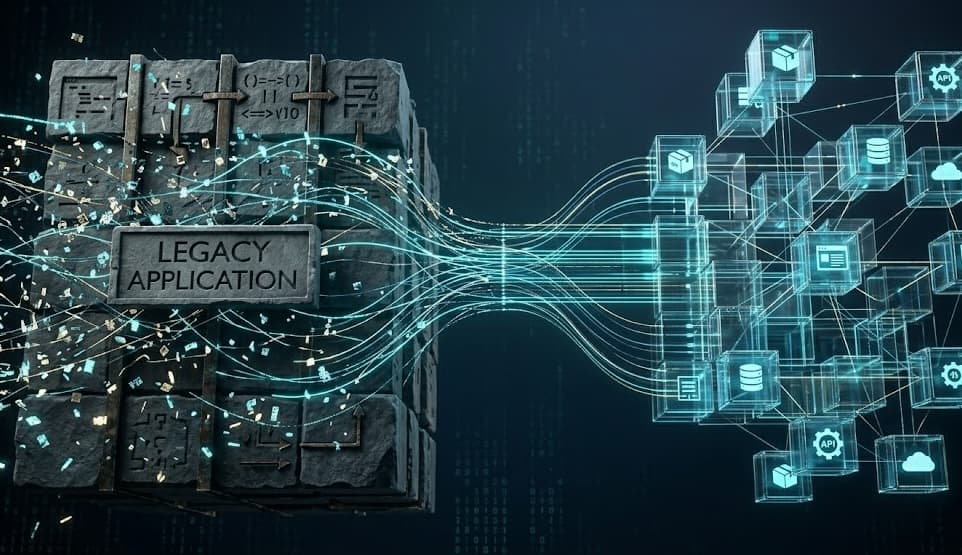
App modernization in 2026 is no longer a simple lift-and-shift to the cloud. It's a structured program that blends cloud-native architectures, AI-assisted refactoring, disciplined data management, and security by design. This guide walks CIOs and engineering leaders through modern modernization strategies — the 7 Rs framework, the toolchain across the full lifecycle, cloud and hybrid patterns, and the KPIs that prove modernization actually delivered business value.
Alexander Stasiak
Apr 08, 2026・13 min read

How Quantum Computing is Transforming Application Development
Quantum computing is opening new horizons in application development — from faster problem-solving to entirely new software possibilities.
Alexander Stasiak
Apr 14, 2025・15 min read

AI Agents for Predictive Maintenance and Asset Reliability
How autonomous agents read vibration, thermal and acoustic data to predict failures weeks ahead — and act on them without waiting for a human.
Alexander Stasiak
Aug 29, 2026・9 min read
Recently added

How Startup House Cut Leasing Applications to 2 Minutes for Siemens Financial Services
Leasing used to mean paperwork, manual credit checks, and decisions that waited for office hours. For Siemens Financial Services Poland, Startup House replaced that with SimplyLease Online: an application customers complete in about 2 minutes and an automated credit decision delivered in about 7, at any hour. This case study shows how the platform was built within Siemens Group security standards, how it connects to Siemens systems and external data providers, and what a partnership running since 2016 has delivered. It closes with three lessons that apply to almost any financing or lending product.
Alexander Stasiak
Oct 06, 2026・5 min read

How a Cybersecurity Platform Serving Fortune 500 Clients Cut Onboarding by 95% with an AI Agent Built by Startup House
A cyber risk platform trusted by Fortune 500 companies had a familiar problem: customers respected it but opened it once a quarter, and onboarding took 45 minutes of guided setup. Startup House built Aria, an AI agent embedded inside the product, with a four-layer interface that serves board members, CFOs, and CISOs in one panel. Onboarding dropped by 95% to under 2 minutes, data exploration became fully self-serve, and the platform turned into a daily decision-support tool. This case study explains the interface, the tenant-isolation architecture, and why none of it required touching the platform's core codebase.
Marek Pałys
Oct 05, 2026・5 min read

AI and Digital Projects by Startup House: 5 Measurable Outcomes in Numbers
Claims are easy in software development, so this article sticks to numbers. It walks through five outcomes from Startup House client projects, from a 95% cut in onboarding time with an embedded AI agent to a 40% reduction in development costs for Omnipack. Each section says what kind of work produced the number and links to the public case study behind it. The closing section names three patterns these projects share, worth borrowing whether or not you work with us.
Alexander Stasiak
Oct 04, 2026・5 min read

Healthtech Software Development at Startup House: Compliance-First Projects and Results
In healthcare software, compliance is either an architecture decision or a retrofit. This article shows what designing it in from day one looks like across three Startup House projects: a sales platform for Siemens Healthineers active in more than 60 countries, a dementia care MVP shaped by 7 user testing sessions with patients and caregivers, and Doogie, a HIPAA-grade AI showcase built in 2 months. It also explains how RAG keeps clinical AI answers traceable to verified sources, and why patient data is never used to train models. For MedTech companies and health SaaS platforms, it is a practical look at what compliance-first engineering means beyond the label.
Marek Pałys
Oct 03, 2026・5 min read
Edtech Development at Startup House: What We've Built and What It Changed
EdTech platforms fail for UX reasons more often than technical ones: learners drop off, content doesn't scale, and ROI stays invisible. This article shows how Startup House avoids that with phased delivery and real user testing, using two projects as proof. Graspify went from a bold idea to a microlearning platform that trained hundreds of employees during a corporate event, and LITTLEWINE got an investor-ready scope from 10 user interviews in 2 weeks. It also covers AI learning tools that answer only from approved content and can go live in as little as 2 weeks.
Alexander Stasiak
Oct 02, 2026・5 min read

AI in Fintech: Startup House Projects, Lessons, and Outcomes
Fintech customers expect consumer-grade speed, while regulators expect bank-grade control. This article shows how Startup House has handled that tension in three projects: automated 24/7 credit decisions for Siemens Financial Services, a cyber risk platform that grew revenue 150% in a year, and a climate fintech team for CHOOOSE assembled in 2 weeks. Each project comes with the lesson it taught us. The article closes with five rules for AI in finance, from grounding every answer in verified data to designing tenant isolation into the architecture.
Marek Pałys
Oct 01, 2026・5 min read
Ready to centralize your know-how with AI?
Start a new chapter in knowledge management—where the AI Assistant becomes the central pillar of your digital support experience.
Work with a team trusted by top-tier companies.


